



26 Jun The Rise And Use Of Decorative Chinoiserie Murals
How two very different London commissions demonstrate the versatility of hand-painted Chinoiserie murals
The Enduring Appeal of Chinoiserie
In previous articles, I have explored the history of Chinoiserie and its relationship to interior decoration.
Since writing those blogs, the popularity of Chinoiserie murals has continued to grow. Increasingly, homeowners, interior designers and architects are choosing hand-painted Chinoiserie as an alternative to wallpaper, creating interiors that are both highly personal and unique.
As a mural artist based in London, I have recently completed several Chinoiserie mural commissions, both in the UK and internationally. What is particularly interesting is how differently these murals can function within an interior.
Two recent London projects illustrate this perfectly.
One was designed to become the dominant feature of a room, while the other was intended to support and enhance an already sophisticated decorative scheme.
Chinoiserie as the Focal Point of a Room
A Bedroom Commission in Northfields
The first commission was in Northfields, West London, within the Borough of Ealing.
Although often overlooked compared to some of London’s more fashionable districts, Northfields has a strong village atmosphere, mature gardens and a thriving community. The clients lived in a colourful and characterful home filled with decorative objects, artwork and paintings of birds.
Their bedroom occupied a loft conversion overlooking neighbouring gardens and they had long dreamed of commissioning a hand-painted Chinoiserie mural.
The ideal location proved to be a bank of built-in wardrobes, creating an uninterrupted surface capable of becoming the room’s principal decorative feature.
Designing the Mural
The clients supplied photographs of the room together with images of high-end Chinoiserie wallpapers that they admired.
Following discussions regarding budget, colour palette and the atmosphere they wished to create, we agreed upon a muted grey-green background with flowers incorporating soft salmon pink tones to complement the fabrics already present within the room.
Communication is always an important part of the design process. Through a series of conversations and sketches, the final composition gradually evolved into a bespoke design tailored specifically to the space.
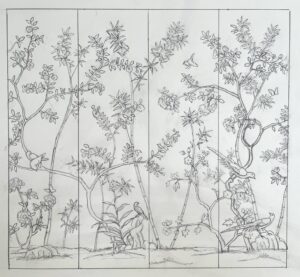
Once the scaled drawing had been approved, the mural was painted in acrylics over a water-based eggshell finish and protected with two coats of water-based varnish.
The Finished Result
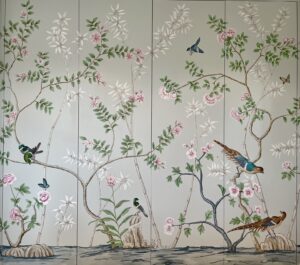
This project is a perfect example of a Chinoiserie mural acting as the primary decorative element within a room.
Rather than supporting the interior, the mural becomes the focal point around which the rest of the decorative scheme revolves.
Chinoiserie as Part of a Wider Interior Scheme
A Hampstead Commission
The second commission could not have been more different.
Located in Hampstead, one of London’s most prestigious residential areas, the property was undergoing a substantial renovation. The house enjoyed extensive views over gardens, playing fields and the London skyline.
Unlike the Northfields project, where the mural was intended to dominate the room, this commission formed part of a carefully orchestrated interior design scheme.
Every element of the project had already been considered in detail, from exotic carved marble wash basins to bespoke mirrors and decorative lighting.
The mural therefore needed to complement the overall design rather than compete with it.
Creating a Pearlescent Chinoiserie Finish
The first stage of the commission involved a ground-floor powder room.
The walls and ceiling had already been painted in a rich chocolate tone, providing an elegant backdrop for the decorative painting.
The clients requested a subtle pearlescent finish beneath the mural, creating a soft reflective quality that would interact with the room’s lighting throughout the day.
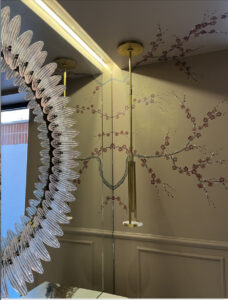
Achieving this effect required considerable experimentation. Various quantities of pearlescent powders were mixed into clear glazes and applied to sample panels before the final finish was selected.
The objective was not to create a highly reflective surface, but rather a subtle luminosity that would enrich the walls without overpowering the decorative painting.
Extending the Design Beyond the Walls
As the project evolved, the design became increasingly bespoke.
Although there was less painted imagery than in the Northfields commission, the complexity of the process increased considerably due to the custom glazes, revised sketches and the decision to allow the branches and blossom to extend onto the ceiling.
This helped dissolve the boundaries of the room and created a more immersive decorative experience.
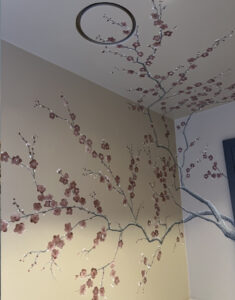
As with the previous commission, the completed mural was protected using two coats of water-based varnish to ensure durability and longevity.
Two Different Approaches to Chinoiserie
These two projects demonstrate something that is often overlooked when discussing Chinoiserie murals. A hand-painted mural does not always need to dominate a room.
Sometimes the mural itself is the principal attraction, becoming the focal point of the interior. In other situations, it plays a more subtle role, supporting the architecture, furnishings and decorative scheme while helping to create atmosphere.
Both approaches can be equally successful when carefully considered.
The key is understanding the character of the space and the aspirations of the client.
Why Choose a Hand-Painted Chinoiserie Mural?
Unlike wallpaper, a bespoke Chinoiserie mural can be tailored precisely to:
The architecture of the room
Existing furnishings and fabrics
Natural light conditions
Personal preferences
Budget requirements
Every mural project becomes unique to the property in which it is created.
For this reason, hand-painted Chinoiserie continues to be one of the most enduring and versatile forms of decorative mural painting.
Frequently Asked Questions
Q. What is a Chinoiserie mural?
A. A Chinoiserie mural is a decorative painted scheme inspired by European interpretations of Asian art. These murals often feature elegant birds, flowering trees, foliage, and idyllic garden landscapes, creating a timeless and sophisticated atmosphere.
Q. Is a hand-painted mural better than wallpaper?
A. A hand-painted mural is designed specifically for a room and can be tailored to its architecture, proportions, and character. Unlike wallpaper, every mural is entirely unique and created exclusively for the property.
Q. How long does a Chinoiserie mural take to complete?
A. The timescale depends on the size and complexity of the design. Smaller feature walls may take several days to complete, while larger and more intricate schemes can require several weeks.
Q. Can Chinoiserie murals be painted on wardrobes?
A. Yes. Built-in wardrobes, cupboards, and other fitted furniture can provide excellent surfaces for decorative painting, transforming functional pieces into beautiful focal points within a room.
Q. Do Chinoiserie murals work in contemporary interiors?
A. Absolutely. Although inspired by historic decorative traditions, Chinoiserie murals can be adapted to suit both traditional and contemporary interiors, offering a distinctive and elegant design feature.
No Comments